
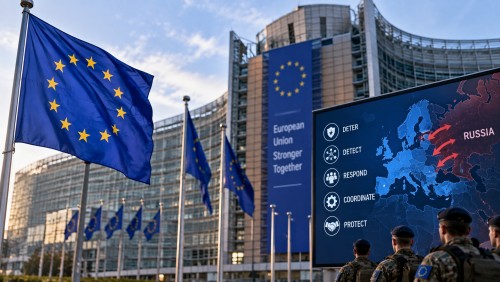
The European Union’s move to create its own emergency security mechanism promises to enhance its ability to respond to threats that, while not amounting to armed aggression, still pose significant risks to member states. This initiative, spearheaded by European Commission President Ursula von der Leyen, aims to address vulnerabilities such as cyberattacks and drone incidents, which have become increasingly common in the modern security landscape.
Announced during her annual State of the Union address, von der Leyen outlined plans for a mechanism akin to NATO’s Article 4. This mechanism would allow EU member states to consult and coordinate their responses to security threats more effectively. As part of a broader European security strategy, expected to be unveiled later this year, the initiative underscores the EU’s commitment to strengthening its defense capabilities.
In addition to the main mechanism, the proposed strategy includes a counter-hybrid playbook designed to bolster the EU’s response to various forms of hybrid warfare. Von der Leyen also introduced the idea of a European Instrument for Strategic Enablers, aligned with NATO, which would enhance capabilities in areas such as air defense, strategic transport, space, and cybersecurity.
The suggestion of forming a European Security Council, which could involve non-EU nations such as Ukraine, the United Kingdom, Norway, and Canada, reflects the EU’s intent to enhance coordination on broader security issues. This initiative highlights the EU’s recognition of the interconnected nature of security challenges that extend beyond its borders.
Ukraine continues to be a priority in the EU’s security agenda, with plans to facilitate its access to US Patriot missiles through the bloc’s financial assistance programs. Additionally, the EU is preparing a defense-industry program that encourages collaboration between European and Ukrainian companies, further integrating Ukraine into the European defense landscape.
These developments indicate a strategic shift within the EU towards more robust and autonomous security measures, aiming to safeguard its member states against an evolving array of threats in a rapidly changing global environment.